Alois Lechner (1893–1940)Innsbruck police officer, Dachau prisoner and victim of Nazi persecution9/18/2026 Language / Sprache: EN | DE Alois Lechner (1893–1940)  Police Inspector Alois Lechner (1893–1940) in uniform with decorations, photographed before 1938. Digitally edited historical photograph. Source: Historical Archive of the Tyrol Provincial Police Directorate – Police History Study Group; sent by Peter Hellensteiner by email. The image is also listed by the Mauthausen Memorial with a credit to the Innsbruck City Archives. Niko Hofinger granted Elisabeth Walder permission to use it in DBANT by email on 28 September 2026. Alois Lechner was an Innsbruck police officer who had taken action against members of the then-illegal Nazi Party before 1938. Immediately after the Nazi takeover of Austria, he was arrested and deported to Dachau concentration camp. Among the Tyrolean prisoners transported with him was Dr Ernst Verdross. In September 1939, Lechner was transferred to Mauthausen concentration camp. He died there on 19 February 1940 following severe abuse. His life illustrates the persecution of Austrian police officers who had acted against the illegal Nazi movement before 1938. Early life and family Alois Lechner was born in Innsbruck on 2 August 1893. His father, Josef Lechner, was a master shoemaker; his mother was Christiane Lechner, née Baldauf. Lechner began training as a locksmith. On 28 July 1914, the day Austria-Hungary declared war on Serbia, he was called up for basic military training. He served in the 2nd Regiment of the Tyrolean Kaiserjäger and received the Bronze Medal for Bravery. In May 1915, he sustained a gunshot wound to his right foot. Because of this injury, he worked as a locksmith at the Poldihütte munitions factory in Kladno, near Prague, from September 1915 to May 1917 under wartime service regulations. Called up again, he became an Italian prisoner of war in November 1918. Lechner returned to Innsbruck on 17 June 1919 and was formally discharged from military service. That autumn, he joined the Austrian customs and finance guard. In 1920, he married Anna Thaler. Their three sons were born in 1921, 1922 and 1924. Police career in Innsbruck  The Golden Roof in Innsbruck with its richly decorated oriel. Black-and-white adaptation of a colour photograph. Source: Wikimedia Commons, “Innsbruck Goldenes Dachl pc.jpg”. In February 1921, Lechner joined the Innsbruck municipal police force, beginning a long career with the city’s police. He received the Great Silver Medal of Merit for his service in 1935. Two years later, he was promoted from precinct inspector to district inspector. He commanded the police post responsible for the Innsbruck city centre and town hall area. His duties included investigating violence and other offences associated with the Nazi movement. While the Nazi Party was banned in Austria, Lechner questioned people accused of crimes connected with its illegal activities. After the Nazi takeover, this earlier police work became a major reason for his persecution. Arrest after the Nazi takeover of Austria  Arrests in Innsbruck following the entry of German troops into Austria on 12 March 1938. AI-generated illustration; not a historical photograph. The people depicted are not identified historical individuals. On 12 March 1938, the day German troops entered Austria, Lechner was arrested at his workplace. He was taken to the Innsbruck police detention facility known as “Die Sonne”. The Nazis placed him in so-called “protective custody”. Despite its name, this was an instrument of persecution: people could be detained indefinitely without an ordinary court hearing and sent to a concentration camp. Several appeals for clemency on Lechner’s behalf were unsuccessful.  National Socialist rally in front of the town hall in Hall in Tirol. This historical photograph conveys an impression of the political climate in which Police Inspector Alois Lechner (1893–1940) was persecuted. Historical photograph, AI-assisted restoration and post-processing. Source: DBANT. On 12 March 1938, the day German troops entered Austria, Lechner was arrested at his workplace. He was taken to the Innsbruck police detention facility known as “Die Sonne”. The Nazis placed him in so-called “protective custody”. Despite its name, this was an instrument of persecution: people could be detained indefinitely without an ordinary court hearing and sent to a concentration camp. Several appeals for clemency on Lechner’s behalf were unsuccessful.  Symbolic depiction of a prisoner transport to Dachau concentration camp. AI-generated black-and-white image, not a historical photograph. Source: DBANT. Deportation to Dachau concentration camp 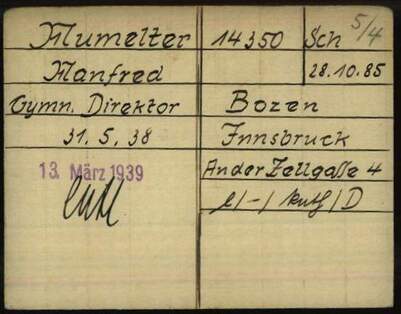 Prisoner card for Alois Lechner at Dachau concentration camp. It records his name, prisoner number 14342, date of birth, occupation as a police officer, residence in Innsbruck and admission on 31 May 1938. The red notation “M 27 Sep. 1939” probably refers to his impending transfer to Mauthausen concentration camp. On 31 May 1938, Lechner was deported to Dachau concentration camp with other people persecuted in Tyrol. A surviving prisoner card gives his Dachau number as 14342; the camp’s admission register records 14352. The discrepancy is explained below. The Tyrolean lawyer and resistance figure Dr Ernst Verdross, from Hall in Tirol, was on the same transport. He was registered at Dachau under prisoner number 14354. Verdross later mentioned Lechner in his account of his imprisonment at Dachau. Elisabeth Walder published this original source in 2025 as KZ-Dachau Häftlingsnummer 14354. Dr. Ernst Verdross.  Extract from the Dachau concentration camp admission register for Tyrolean prisoners admitted on 31 May 1938. Alois Lechner appears with prisoner number 14352, his date of birth, the occupation “Polizei-Leutnant” and his Innsbruck address, Erzherzog-Eugen-Straße 29. Dr Ernst Verdross appears two lines below him with prisoner number 14354. Source: Arolsen Archives – International Center on Nazi Persecution. Source note: conflicting Dachau prisoner numbers The surviving sources give two different Dachau prisoner numbers for Alois Lechner. The Documentation Centre of Austrian Resistance (DÖW) lists 14352, as does the historical Dachau admission register. Dr Ernst Verdross, who arrived on the same transport, appears nearby in the register under number 14354. By contrast, Lechner’s biography in Raum der Namen, the digital memorial book of the Mauthausen Memorial, gives 14342 for his imprisonment at Dachau. The same number appears on a historical prisoner card. The available records do not establish whether this difference resulted from a clerical or transcription error, a later correction, or another aspect of the registration process. Both recorded numbers are therefore given here. Resolving the discrepancy would require comparison of all surviving Dachau prisoner records and, potentially, clarification from the Arolsen Archives or the Dachau Concentration Camp Memorial archive.  Prisoners at Dachau concentration camp performing forced labour. Several prisoners wearing striped camp uniforms jointly push a heavy tipping wagon along a narrow-gauge railway track through the camp grounds. Source: German Federal Archives (Bundesarchiv), Image 152-26-20, via Wikimedia Commons, licensed under CC BY-SA 3.0 DE; available online (accessed 18 September 2026). Transfer to Mauthausen concentration camp  Entrance to Mauthausen concentration camp, showing the camp gate and the massive stone fortifications. Source: German Federal Archives (Bundesarchiv), Image 192-342, via Wikimedia Commons, licensed under CC BY-SA 3.0 DE; available online (accessed 19 September 2026). After more than a year at Dachau, Lechner was transferred to Mauthausen concentration camp on 28 September 1939. He was registered there under prisoner number 14352. Prisoners at Mauthausen faced extremely harsh forced labour, inadequate food, systematic abuse and deliberate killing. Lechner survived only a few months there. He died on 19 February 1940, aged 46, following severe abuse. Death following severe abuse  Entry for Police Inspector Alois Lechner in a list of police officers who lost their lives. The list records his death at Mauthausen concentration camp on 19 February 1940. Source: Historical Archive of the Federal Police Directorate for Tyrol – Working Group on Police History; provided to Elisabeth Walder by Peter Hellensteiner via email. According to the Mauthausen Memorial, documentary evidence establishes that Lechner died as a result of severe abuse. The exact sequence of events has yet to be established with certainty. Family accounts state that his body, laid out at the crematorium in Steyr, bore bruises and injuries across it. His widow Anna is said to have travelled to Steyr or Mauthausen with their son Karl, then aged 15, to say goodbye. In her autobiographical account, Leokadia Justman relates Anna Lechner’s distressing description. According to this account, the condition of his body showed the family that he had been severely abused and beaten to death. Later accounts say that Lechner was tied to a hospital cot and beaten with rifle butts. They also suggest that the attack reenacted an interrogation method allegedly used by the Innsbruck police before 1938. These details have been linked to postwar proceedings but still require verification against the relevant court and trial records.  Death certificate for Alois Lechner, issued by the Mauthausen registry office on 28 February 1940. It records his death in Mauthausen at 1 a.m. on 19 February 1940, along with details of his birth, parents, wife Anna and Innsbruck address. The official cause of death was entered as “influenza, cardiac and circulatory weakness”. This entry conflicts with sources attributing his death to severe abuse at Mauthausen concentration camp. Source: Arolsen Archives – International Center on Nazi Persecution.  Entry for Alois Lechner in the death register of Mauthausen concentration camp. His departure on 19 February 1940 is recorded with the notation “verstorben” (“deceased”). The page lists his prisoner number as 14352. Source: Arolsen Archives; preserved in the Historical Archive of the Federal Police Directorate for Tyrol – Working Group on Police History; provided to Elisabeth Walder by Peter Hellensteiner via email. Source note for placement beneath the image: The death certificate confirms that Alois Lechner’s death was officially registered on 19 February 1940. Its stated cause—“influenza, cardiac and circulatory weakness”—must be treated with caution. Concentration camp death certificates often relied on information supplied by camp authorities and could conceal violence and the effects of imprisonment. Other sources attribute Lechner’s death to severe abuse; the precise events remain incompletely documented. Remembering Alois Lechner  Memorial plaque at the Federal Police Directorate on Kaiserjägerstraße in Innsbruck. Beneath the dedication “Den Opfern der Pflicht” (“To the victims of duty”), it lists Police District Inspector Alois Lechner and his date of death, 19 February 1940. Source: Historical Archive of the Tyrol Regional Police Directorate – Police History Working Group; sent to Elisabeth Walder by Peter Hellensteiner via email. The consequences for Anna Lechner and their children Lechner’s arrest and death had grave consequences for his family. After the Nazi takeover, his wife Anna lost the financial payments to which she was entitled, leaving the family in increasing hardship. The Gestapo also arrested one of their sons after he made critical remarks about the Hitler Youth to the woman who employed him as an apprentice. Karl Lechner, born on 15 March 1924, was later conscripted into the German armed forces. He died as a soldier on 30 December 1944 in Rüllingen-Wilz, Alsace. Anna supported herself and her children under difficult conditions, including by working as an itinerant seamstress for farming families around Innsbruck. Because she worked long hours, she was accused of neglecting one of her children. The Innsbruck Nazi Party district leadership involved the youth welfare office, and for a time Anna faced the threat that her child would be taken away. The family was also socially isolated. Neighbours and acquaintances insulted Anna because her husband had been sent to a concentration camp. According to family accounts, eventually only one grocery shop in her neighbourhood was willing to serve her. Anna Lechner and Leokadia Justman The Lechner family’s story is closely connected with the survival of Leokadia Justman, a Polish Jewish woman persecuted by the Nazis. Using false papers, Justman lived as a Polish worker under the name “Lotte”. She later described meeting Anna Lechner. For a time, Justman and her father rented rooms in Anna’s Innsbruck home. Anna also helped the young woman seek other safe accommodation. Through Anna, Justman made important contacts with people who gave her shelter and assistance after her escape from detention in 1945. Anna’s own experience of persecution, social exclusion and her husband’s violent death may have shaped her understanding of the danger facing Justman. After the war Following liberation, Anna Lechner sought benefits under Austria’s Victims’ Welfare Act, with support from the Association of Victims of Nazi Oppression in Tyrol. The family’s financial circumstances remained difficult for years. Persecution had exhausted their resources, and an extended family weekend house that had at times served as a refuge had to be sold. Only in the 1950s did Anna receive back payments of pension benefits withheld from her during Nazi rule. She died in Innsbruck on 21 September 1959. Historical context Lechner’s biography shows how abruptly the position of some Austrian police officers changed in March 1938. Before the Nazi takeover, he had investigated members of the illegal Nazi movement. Afterwards, he was arrested and deported to concentration camps. The sources document his opposition to Nazism and his persecution by the Nazi regime. They do not currently establish that he belonged to an organised resistance group. The historically precise description is therefore a politically persecuted police officer and victim of Nazism. His story intersects with Dr Ernst Verdross’s account of Dachau and Leokadia Justman’s survival story. Together, these accounts illuminate imprisonment, the suffering of prisoners’ families and the practical help offered to a Jewish woman in danger. A note on the sources The biographical information about Lechner draws particularly on Raum der Namen, the Mauthausen Memorial’s digital memorial book. Its entry was written by Thomas Thaler, a grandson of Anna Lechner, and combines documented facts with family accounts. The Mauthausen Memorial describes Lechner’s death following severe abuse as documented. The precise circumstances, however, have not been fully established. Until the relevant court or trial records have been examined, the account that he was tied down and beaten with rifle butts should be identified as a report requiring further verification. In Leokadia Justman’s memoir, Anna Lechner refers to her husband as “Luis”. His life dates, occupation and the persecution described make clear that she meant Alois Lechner. Conclusion Lechner lost his life following his arrest and imprisonment by the Nazi regime. Arrested on 12 March 1938, he was deported first to Dachau and then to Mauthausen, where he died on 19 February 1940 after severe abuse. His widow Anna also faced exclusion and financial hardship. Even so, she helped Leokadia Justman, a Jewish woman in danger, and put her in touch with people who later assisted her. The Lechner family’s history brings together political persecution, concentration camp violence, family suffering and acts of help under dictatorship. Alois Lechner at a glance Born 2 August 1893, Innsbruck Occupation Locksmith, customs and finance guard officer, police officer Rank District Inspector Police post Innsbruck city centre / town hall area Arrested 12 March 1938 Deported to Dachau 31 May 1938 Dachau prisoner number 14342 on a prisoner card; 14352 in the admission register and DÖW records Transferred to Mauthausen 28 September 1939 Mauthausen prisoner number 14352 Died 19 February 1940, Mauthausen concentration camp Historical classification Politically persecuted police officer and victim of Nazism Frequently asked questions (FAQ) Who was Alois Lechner? He was an Innsbruck police officer and district inspector. Before 1938, his duties included action against the illegal Nazi movement. After the Nazi takeover of Austria, he was arrested and imprisoned at Dachau and Mauthausen. When and where was he born? He was born in Innsbruck on 2 August 1893. His parents were Josef Lechner, a master shoemaker, and Christiane Lechner, née Baldauf. Why did the Nazis persecute him? Before 1938, Lechner had taken part in police measures against people associated with the Nazi Party, which was then banned in Austria. He was arrested at his workplace on 12 March 1938. When was he deported to Dachau? Lechner was deported with other Tyrolean prisoners on 31 May 1938. What was his connection to Dr Ernst Verdross? They were on the same Tyrolean transport to Dachau. Verdross later mentioned Lechner in his account of his imprisonment. What was Lechner’s Dachau prisoner number? The surviving sources disagree. A historical prisoner card and the Mauthausen Memorial give 14342; the Dachau admission register and DÖW give 14352. The reason remains unresolved. When was he transferred to Mauthausen? He was transferred from Dachau on 28 September 1939. When and how did he die? Lechner died at Mauthausen on 19 February 1940. The Mauthausen Memorial states that his death following severe abuse is documented, although the precise events cannot yet be fully reconstructed. What cause of death appears on his death certificate? The official entry reads “influenza, cardiac and circulatory weakness”. It conflicts with sources attributing his death to severe abuse. What happened to his family? His widow Anna and their children faced financial hardship and social exclusion. Their son Karl was later conscripted and died in Alsace in December 1944. How was Anna Lechner connected to Leokadia Justman? Justman and her father stayed for a time in Anna’s Innsbruck home. Anna also introduced Justman to people who later helped her find safety. Was Alois Lechner a member of the resistance? The evidence establishes his opposition to Nazism and his persecution for earlier police work. Membership in an organised resistance group has not been demonstrated. Suggested “Read more” links 31. Mai 1938 - Deportation KZ-Dachau🇬🇧 Verdross -Dr. Ernst -Biography🇬🇧/dr-franz-pessler-lawyer-dachau-prisoner🇬🇧 Corazza- Friedrich Blog (EN)🇬🇧 Blog (EN) Dr. _Manfred _Mumelter🇬🇧Bodenwinkler-Anton-Memorial-Blog (EN)🇬🇧 Killinger-Karl-Memorial-Blog (EN)
0 Comments
|
Author
|
 RSS Feed