Language / Sprache: EN | DEJehovah’s Witnesses in Hall in Tyrol – Nazi Persecution Introduction The history of Jehovah’s Witnesses forms part of the history of Nazi persecution in Hall in Tyrol, Austria, and the surrounding region. This article focuses on Karl Killinger and Anton Bodenwinkler. Both were arrested in 1939, deported to concentration camps and died in 1940. Their lives reveal the consequences of the persecution of a religious minority for individuals and their families. [1, 2] The article places these biographies in their historical context. It explains the persecution of Jehovah’s Witnesses, then often referred to as “Bible Students”, and explores the significance of religious conscience under a dictatorship. General statements about the religious community must be distinguished from documented actions by individuals. Bans and persecution in Austria before 1938 Jehovah’s Witnesses faced restrictions imposed by the Austrian authorities before the “Anschluss”, Austria’s annexation by Nazi Germany. Detlef Garbe describes a ban issued on 17 June 1935 and upheld by the Austrian Federal Court on 7 February 1936. Measures included the confiscation of religious publications, house searches and short periods of detention. This earlier repression must be distinguished from the subsequent Nazi persecution. [3, p. 12] Why the Nazi regime persecuted Jehovah’s Witnesses The purple triangle identified Jehovah’s Witnesses in Nazi concentration camps. Today, it commemorates their persecution and suffering under the Nazi regime. Image credit: Coreyjo, own work, public domain, via Wikimedia Commons: https://commons.wikimedia.org/w/index.php?curid=7436210 (Access: 14 October, 2026) The Nazis demanded political allegiance and submission to their authority. On religious grounds, Jehovah’s Witnesses refused the Hitler salute, the oath of loyalty to Hitler and military service. Their religious commitments therefore conflicted with the regime’s demands. Banned meetings and the distribution of religious literature could also lead to persecution. [4] Persecution intensified after the Nazi takeover of Austria in March 1938. Members of the community faced arrest and imprisonment in concentration camps; conscientious objectors could be sentenced to death. Their refusal to comply with state demands arose from their faith. Historians consider such conduct a form of religiously motivated nonconformity and resistance. [3, 4] Karl Killinger 1901 to 1940 Photo of Karl Killinger. Private Archive of Roland Killinger, 6068 Mils. Karl Killinger was born in Upper Austria on 2 July 1901. He moved to Hall in Tyrol in 1931 and worked as a blacksmith. On 15 May 1938, he married Hedwig Arnold in Innsbruck. He and his family lived at Ritter-Waldauf-Straße 6. Photographs held in Roland Killinger’s private archive preserve the memory of his life before his arrest. [1] As a Jehovah’s Witness, Killinger became a target of Nazi persecution. He was arrested on 16 February 1939 and deported to Dachau concentration camp on 24 March 1939. He died in Gusen on 19 January 1940, aged 38. According to the author, records held by the Arolsen Archives document Gusen as his place of death. [1, 5] His arrest brought his everyday life as a working man, husband and father to an end. A biographical account should therefore consider family sources alongside imprisonment records. These sources restore a human face to the victim and prevent his story from being reduced to a succession of concentration camps.  Photo of Hedwig and Karl Killinger (1938). Private Archive of Roland Killinger, 6068 Mils. 🕯️ Memorial Portrait: Karl Killinger (1901–1940)Memorial _(EN) _Karl _KillingerAnton Bodenwinkler 1911 to 1940Anton Bodenwinkler was born in Lienz on 22 September 1911. His biography forms part of the regional history of the persecution of Jehovah’s Witnesses and is included in the Hall in Tyrol remembrance project. He was arrested on 22 February 1939 and deported to Dachau concentration camp on 2 June 1939. [1, 2] DERLA, the Digital Remembrance Landscape of Austria, records his transfer to Mauthausen concentration camp on 29 September 1939. Bodenwinkler died there on 11 February 1940, aged 28. His membership of Jehovah’s Witnesses is documented; a direct connection between his arrest and a specific refusal of military service is treated as a hypothesis in the research. [2] This distinction matters when reconstructing his life. The beliefs of a religious community do not, without further evidence, establish which particular acts an individual was accused of committing. A precise account of established facts and outstanding questions strengthens the remembrance of Bodenwinkler. 🕯️ Memorial Portrait: Anton Bodenwinkler (1911–1940)Memorial (EN) Anton BodenwinklerThe purple triangle and the declaration renouncing faith Memorial plaque honouring Jehovah’s Witnesses at the former Mauthausen concentration camp in Upper Austria. It commemorates those persecuted for their Christian faith who suffered and died in the camp. Photo: Osch (German Wikipedia), own photograph, 30 December 2006, public domain, via Wikimedia Commons. https://commons.wikimedia.org/wiki/File:KZ_Mauthausen_Mahntafel_ZJ.jpeg (Access: 14 October, 2026) In concentration camps, Jehovah’s Witnesses were identified by a purple triangle. This badge formed part of the prisoner classification system imposed by the SS. Today it can draw attention to the persecution of this group in remembrance work; its origin, however, lies in the perpetrators’ system of identification and exclusion. [4] Another means of coercion was the declaration renouncing faith, known in German as the “Abschwörungserklärung”. By signing it, prisoners were expected to disassociate themselves from their religious community and declare their submission to the regime’s demands. A signature could open the possibility of release. Many Jehovah’s Witnesses refused to sign. Any claim that such a declaration was presented to, or refused by, Killinger or Bodenwinkler requires evidence relating to that individual. [4] Mauthausen Concentration Camp 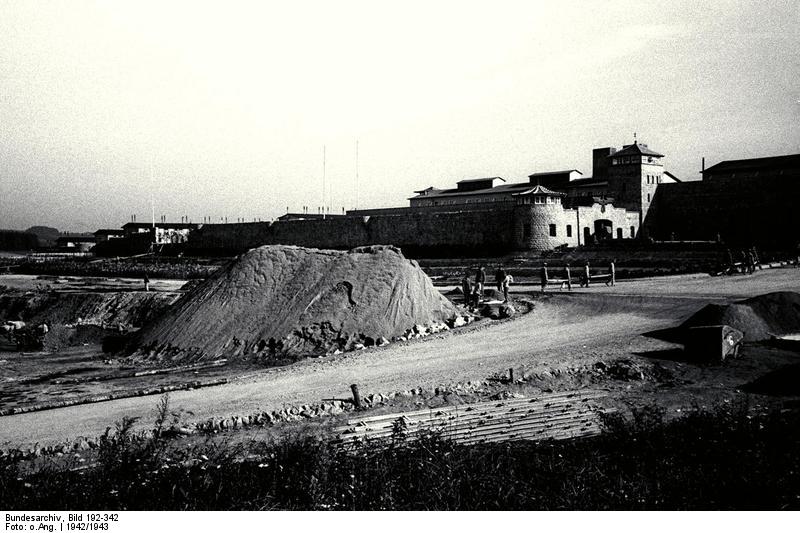 Entrance to Mauthausen concentration camp in Upper Austria, 1942–1943. Image credit: Bundesarchiv, Bild 192-342, CC BY-SA 3.0 DE, via Wikimedia Commons. (Access: 14 October, 2026) Mauthausen concentration camp, established in August 1938 on the banks of the Danube in Upper Austria, was one of the largest and most feared camps in the National Socialist system of terror. Unlike many other camps, Mauthausen was conceived from the outset as a site of annihilation through labour – prisoners were forced to work under inhumane conditions in the notorious granite quarries. The camp served as the centre of an extensive network of more than 40 subcamps, among them the nearby Gusen concentration camp. Its prisoners included political opponents, Jews, Sinti and Roma, prisoners of war, and members of persecuted religious communities – among them Jehovah's Witnesses. Between 1938 and the liberation by American forces on 5 May 1945, an estimated 90,000 to 100,000 people were murdered at Mauthausen and its subcamps. Gusen Concentration Camp  Bundesarchiv, Bild 192-149 / CC-BY-SA 3.0. File: Bundesarchiv Bild 192-149, KZ Mauthausen, Baracken und Wachturm des Lagers Gusen.jpg; Erstellt: etwa 1942 date QS:P571,+1942-00-00T00:00:00Z/9,P1480,Q5727902. Gusen concentration camp, located in the municipality of St. Georgen an der Gusen in Upper Austria, was one of the most brutal camps in the National Socialist camp system. Established as a subcamp of Mauthausen – and at times even larger than the main camp itself – it began receiving prisoners from across Europe in May 1940. Inmates were subjected to forced labour in stone quarries and underground armaments factories, under conditions deliberately designed to destroy them physically. The mortality rate at Gusen was among the highest in the entire Nazi camp system. It is estimated that more than 35,000 people lost their lives there between 1940 and 1945. Heinrich Andergassen and the neighbourhood in HallThe earlier article notes that Karl Killinger and Heinrich Andergassen lived close to one another in Ritter-Waldauf-Straße. Andergassen belonged to the Nazi security apparatus. Their proximity connects two different lives with the same urban setting. [1] Living nearby does not in itself prove Andergassen’s personal involvement in Killinger’s arrest. Without documentary evidence, this question remains open. An account of local history must distinguish established responsibility from a possible connection that still requires investigation. Remembering the victims in Hall in TyrolRemembering Karl Killinger and Anton Bodenwinkler means making their names and lives accessible. Family photographs, residence records, imprisonment documents and historical research serve different purposes. Bringing them together makes it possible to portray the person before persecution as well as their imprisonment and death. People persecuted for their religion belong to the history of National Socialism in Tyrol. Their biographies raise questions about religious freedom, freedom of conscience and the treatment of minorities. Local remembrance work can connect these questions with individual lives while making clear where further sources are needed. SummaryKarl Killinger and Anton Bodenwinkler were victims of Nazi persecution as Jehovah’s Witnesses. Killinger lived with his family in Hall in Tyrol and died in Gusen on 19 January 1940; Bodenwinkler died in Mauthausen concentration camp on 11 February 1940. Their stories connect individual remembrance with the persecution of a religious minority. A careful account preserves their names and distinguishes established biographical facts from open research questions. [1, 2, 5] Frequently asked questions about Jehovah’s Witnesses in Hall in TyrolWho were Karl Killinger and Anton Bodenwinkler? Both were Jehovah’s Witnesses and are commemorated as victims of Nazi persecution in the Hall in Tyrol remembrance project. Killinger was a blacksmith and lived in Hall. Bodenwinkler came from Lienz. Both were arrested in 1939 and died in concentration camp imprisonment in 1940. [1, 2] Why were Jehovah’s Witnesses persecuted by the Nazis?Their religiously motivated rejection of the Hitler salute, the oath of loyalty and military service conflicted with the regime’s demands. Continuing banned religious activities also led to persecution. [4] Where did Karl Killinger die? Karl Killinger died in Gusen on 19 January 1940. His place of death is stated here on the basis of the Arolsen Archives evidence confirmed by the author. [5] Where did Anton Bodenwinkler die? Anton Bodenwinkler died in Mauthausen concentration camp on 11 February 1940. DERLA documents his earlier deportation to Dachau and his transfer to Mauthausen on 29 September 1939. [2] What did the purple triangle mean? The purple triangle was the badge used by the SS to identify Jehovah’s Witnesses in concentration camps. It made their classification as members of this persecuted prisoner group visible. [4] Which sources document this history?Individual imprisonment records, family sources and regional documentation are important for these biographies. This article also draws on the DÖW conference publication on the persecution of Jehovah’s Witnesses, DERLA and the Holocaust Encyclopedia of the United States Holocaust Memorial Museum. [1–5] Sources and further reading[1] Elisabeth Walder: Zeugen Jehovas in Hall in Tirol, earlier website article in German. Source of the local information and the family sources cited there. https://www.ns-widerstand-hallintirol.com/jehovas-zeugen-hall-in-tirol (accessed 14 October 2026). The archives cited in the earlier article were not consulted directly when preparing this revised version. [2] DERLA – Digitale Erinnerungslandschaft Österreich: Tyrol directory of persons, entry for Anton Bodenwinkler. https://gams.uni-graz.at/o:derla.perstir (accessed 14 October 2026). [3] Dokumentationsarchiv des österreichischen Widerstandes (ed.): Zeugen Jehovas – Vergessene Opfer des Nationalsozialismus? Referate und Berichte der wissenschaftlichen Tagung vom 29. Jänner 1998. Vienna, 1998. Especially Detlef Garbe, pp. 11–20. In German. https://www.doew.at/cms/download/bfdqi/ZJ_OPFER%20ACROBAT.PDF [4] United States Holocaust Memorial Museum: Nazi Persecution of Jehovah’s Witnesses. Holocaust Encyclopedia. https://encyclopedia.ushmm.org/content/en/article/nazi-persecution-of-jehovahs-witnesses (accessed 14 October 2026). [5] Arolsen Archives: individual records relating to Karl Killinger. According to the author, these document Gusen as his place of death. The relevant record was not available for direct examination when this revised version was prepared. The document number and precise reference should be added to the final citation. Karl Killinger memorial portrait in English: https://www.ns-widerstand-hallintirol.com/memorial-en-karl-killinger Anton Bodenwinkler memorial portrait in English: https://www.ns-widerstand-hallintirol.com/memorial-en-anton-bodenwinkler Further reading on DBANT:Heinrich Andergassen part 1,2,3Book _ Presentation _Concentration Camp DachauDr. Ernst VerdrossBlog (ENI) Dr. Josef MairBlog (EN) Heinrich Andergassen (Part I)read more:www.mauthausen-memorial.org/enwww.kz-gedenkstaette-dachau.de/en/historical-site/dachau-concentration-camp-1933-1945/www.mauthausen-memorial.org/en/History/The-Mauthausen-Concentration-Camp-19381945/The-Gusen-Branch-Camp
0 Comments
Leave a Reply. |
AuthorElisabeth Walder
|
 RSS Feed
